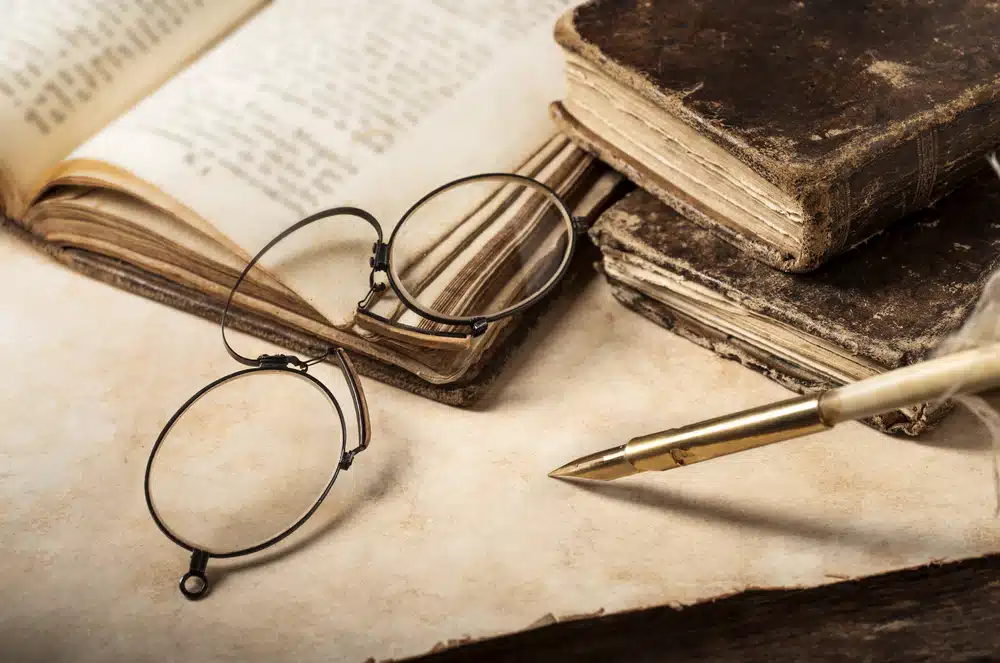
Eyeglasses, as we know them today, are part of everyday life. Yet, most of us rarely stop to think about how far they’ve come over the years. From simple magnifying stones to sleek designer frames and smart lenses, the evolution of eyeglasses mirrors human ingenuity. What began as a practical solution to poor eyesight has become an intersection of science, technology, and style.
Contents
1000 AD: The Reading Stone
It’s believed that the first invention designed to aid vision was the reading stone, which became widely used in 1000 AD. Generally, these stones were made of rock crystal, like quartz or glass. People would place the stone over the text and glide it as they read. It would work much like a magnifying glass. While incredibly simple, the concept of the reading stone laid the foundation for modern magnifiers, reading glasses, and even camera lenses centuries later.
13th Century: The First Eyeglasses
The first wearable eyeglasses were invented in Italy in the late 13th century; however, the actual identity of the inventor remains unknown. Initially, these glasses were worn by scholars and monks. They had no temples (side pieces) and were simply held in front of the eyes or balanced on the nose. The glasses themselves were framed in leather, and this style was worn until 1452, when the increased production of books and the rise of literate citizens demanded new designs and mass production. This was also the century when scientists began experimenting with convex lenses, which are used for farsightedness today. Because the 13th-century glasses were handmade and expensive, early spectacles symbolized intellect and privilege—a far cry from today’s everyday accessibility.
15th Century: The Birth of Vision Correction
Concave lenses were invented after convex lenses and were developed to correct nearsightedness. Generally, this lens is thought to have been invented by Nicholas Krebs, a Cardinal of the Roman Catholic Church. By the 17th century, people began to understand the science behind concave and convex lenses, and they became more widely used to correct vision issues related to distance. As understanding of optics improved, so did people’s willingness to embrace eyeglasses, setting the stage for designs that combined both function and comfort.
The 1700s: Form Meets Function
The next point of extensive development for eyeglasses occurred in the 1700s. In this century, eyeglasses included temples to secure the frames over the ears. They were also made by hand. By the late 1700s, glasses were no longer just for reading; they had become daily essentials for merchants, scientists, and professionals.
Common Styles
- Wig Spectacles: This particular style of glasses was characterized by the long temple pieces that extended over the ears. They were called wig spectacles because they had a loop on the temple ends to be inserted into a wig. These glasses were popular among men of higher classes—some wore them as a symbol of status rather than out of necessity.
- Bifocals: A common type still used today. The bifocal was invented in 1784 by Benjamin Franklin. They include a lens that can accommodate both short and long vision. Franklin’s bifocals revolutionized multifocal vision correction, influencing even the modern progressive lenses used today.
The 1800s: Industrial Innovation

As literacy and education continued to spread, so did the demand for reliable eyeglasses. Luckily, the Industrial Revolution reshaped every aspect of production, including eyewear. For the first time, eyeglasses were mass-produced and affordable for the general public. Improved manufacturing meant consistent quality and accessibility, making vision correction no longer a privilege of the wealthy. During the 1800s, people were finally able to purchase glasses for reasonable prices from many shops and merchants.
Common Styles
- Lorgnette: In the 1800s, there was a societal view that wearing glasses was a sign of ill health and old age. For this reason, people wanted to avoid wearing glasses. The Lorgnette was a clever compromise. The design featured a pair of glasses, but with one long handle instead of temples. The Lorgnette became a social accessory, seen at opera houses and elegant gatherings—an early glimpse of eyewear as fashion.
- Quizzing Glasses: These compact, oval-shaped glasses were characterized by their miniature lenses, delicate frames, and a single handle. Quizzing spectacles were not just a practical solution for vision correction but also a fashion statement. Their elegant designs made them a symbol of sophistication and charm for both men and women of the era.
The 1900s: The Era of Style
During the 1900s, the manufacturing of eyeglasses became a thriving industry in its own right. The range of styles available expanded as Hollywood grew and celebrities began to influence the fashions of the time. By the mid-20th century, eyewear brands began associating frames with personality. Glasses weren’t just corrective tools; they became statements of identity, worn proudly both on and off screen.
Common Styles
- Pince-Nez: This style was popular from 1900 to 1920. It was a French style featuring a small frame that fits snugly over the face and pinches the nose. It usually didn’t come with any temple arms or handles.
- Round Lenses: Thanks to the Hollywood actor Harold Lloyd, the Pince-Nez was mercilessly thrown out of favour in the late 1920s. The style was replaced by a large round lens inside a tortoiseshell frame.
- The Upsweep: In the 1940s, the frame of the moment featured an upsweep on the top rim, simulating the sweep of a woman’s eyelashes. The frames themselves became available in a variety of colours.
The decades that followed would see even greater innovation, from new materials to digital-era lens technologies.
21st Century: Technology and Personal Expression
Since the 1950s, the styles and types of eyeglasses available have become numerous, and fashion changes by the year rather than the decade. In the 21st century, eyeglasses are a fashion statement as much as a practical necessity and countless designers have turned their talents to creating the styles of the moment. Here are some of the popular styles of the modern day:
- Wayfarer Glasses: Characterized by their bold, square-shaped frames. Wayfarer glasses often feature thick frames that come in various colours and patterns. These frames offer a classic, retro-inspired look that appeals to individuals seeking a balance between vintage and contemporary fashion.
- Rimless/Semi-Rimless Glasses: These glasses are minimalist by design. These frames are incredibly lightweight and discreet, as they lack a traditional frame around the lenses. The temples are often attached directly to the lenses, giving them the impression of the glasses floating on the wearer’s face. Rimless and semi-rimless styles provide a clean and modern aesthetic, allowing the focus to remain on the eyes.
- Cat-Eye Glasses: Cat-eye glasses are known for their unswept outer corners, which create a feline-inspired, retro look. The frames come in various materials and colours, but they always maintain this distinctive shape.
Moreover, today’s eyewear is no longer just about design and functionality. Lens technology has advanced far beyond basic vision correction, offering blue-light protection for screen use, photochromic lenses that automatically darken in sunlight, and even “smart glasses” with voice interaction, translation, and photo recognition. Ultra-thin, lightweight materials make glasses more comfortable, while anti-reflective and scratch-resistant coatings improve clarity and durability. You can even find eco-friendly options made from recycled materials or plant-based acetates.
Find Your Style at Laurier Optical
At Laurier Optical, we’re proud to offer a wide range of styles and designer glasses at accessible prices. Whether you’re inspired by vintage wire rims or bold, modern frames, our team helps you find your perfect fit—with precision lenses made right on-site. Contact us today to learn more.